

Introduction
Artificial Intelligence (AI) is rapidly transforming the global balance of power. Once considered a futuristic technology limited to research labs and academic institutions, AI is now becoming a central component of economic growth, military strategy, cybersecurity, and political influence. Governments around the world increasingly view AI not just as a technological innovation but as a strategic geopolitical weapon capable of shaping the future of global dominance.
The race for AI leadership is primarily driven by major global powers such as the United States, China, the European Union, and emerging technology players like India and South Korea. These countries recognize that control over AI technologies can determine economic competitiveness, military superiority, and national security.
Unlike traditional weapons such as nuclear arms or missiles, AI operates in a less visible but equally powerful domain—data, algorithms, and computing infrastructure. As the global competition for AI dominance intensifies, the technology is becoming one of the most important geopolitical battlegrounds of the 21st century.
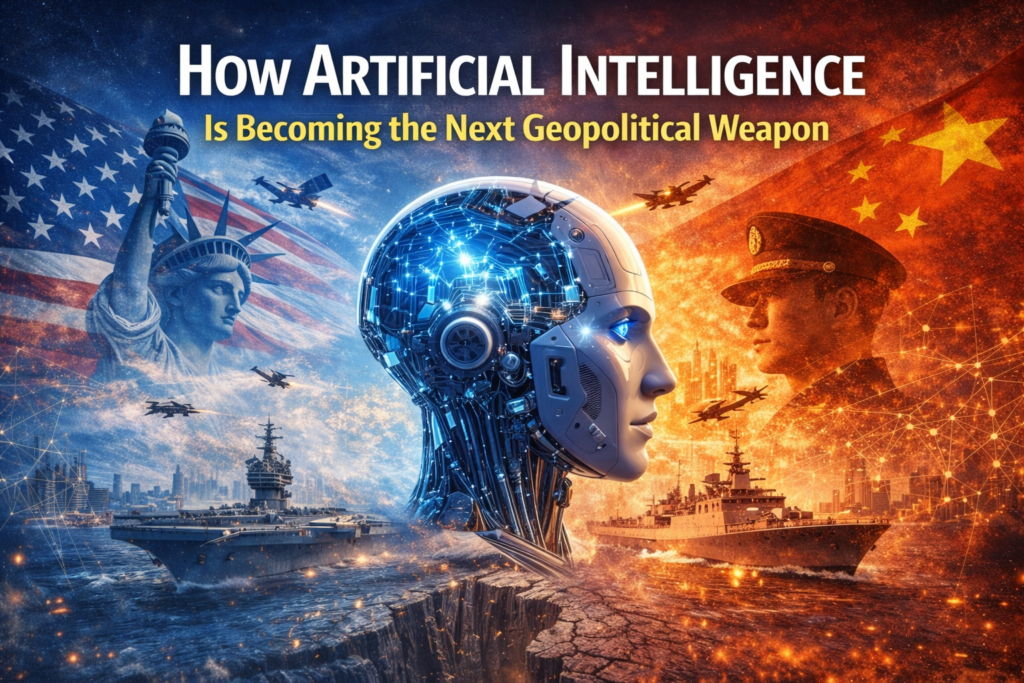
The Global AI Race
The competition for AI leadership is often compared to historical technological races such as the Space Race during the Cold War. However, the stakes today are arguably even higher because AI has applications across nearly every sector of society.
Countries leading in AI development gain advantages in areas such as:
- Military operations
- Economic productivity
- Cybersecurity
- Intelligence gathering
- Autonomous systems
- Advanced manufacturing
The United States currently maintains a strong lead in AI research and development, supported by major technology companies such as Google, Microsoft, OpenAI, and NVIDIA. These companies are at the forefront of developing advanced machine learning models, cloud computing platforms, and AI-powered software systems.
Meanwhile, China has emerged as one of the strongest competitors in the AI race. The Chinese government has declared AI development a national priority and aims to become the global leader in AI by 2030. Chinese companies such as Baidu, Alibaba, Tencent, and Huawei are heavily investing in AI research and development.
This competition between the United States and China is shaping global technological strategies and influencing how other countries approach AI development.
AI and Military Transformation
One of the most significant geopolitical implications of AI lies in its military applications.
Artificial intelligence is transforming modern warfare by enabling advanced technologies such as:
- Autonomous drones
- AI-assisted surveillance systems
- Smart missile guidance
- Predictive battlefield analytics
- Cyber warfare systems
Autonomous weapons systems, often referred to as “killer robots,” are capable of identifying and attacking targets without direct human control. These systems raise serious ethical and security concerns, as they could potentially accelerate conflicts and reduce human oversight in military decisions.
AI is also being used to enhance intelligence gathering and threat detection. Military forces can analyze massive amounts of data from satellites, sensors, and communication networks to identify potential threats more quickly and accurately.
The integration of AI into defense systems is therefore becoming a critical factor in determining future military superiority.
Cyber Warfare and Digital Espionage
Another area where AI is transforming geopolitics is cyber warfare.
Cyberattacks have already become a common tool used by governments to disrupt rival nations’ infrastructure, steal sensitive data, and influence political processes. With the addition of AI, these cyber capabilities are becoming even more powerful.
AI can be used to automate hacking operations, analyze network vulnerabilities, and create more sophisticated cyberattacks that are difficult to detect.
At the same time, AI is also improving cybersecurity defenses by enabling faster threat detection and automated responses to cyber intrusions.
This technological arms race between offensive and defensive cyber capabilities is creating a new domain of geopolitical competition in cyberspace.
The Role of Data in AI Power
Data has often been described as the “new oil” of the digital economy, and it plays a crucial role in AI development.
Machine learning systems rely on massive datasets to train algorithms and improve their performance. Countries with access to large amounts of data therefore gain an advantage in developing advanced AI systems.
China’s large population and extensive digital infrastructure generate enormous volumes of data, which provides valuable training material for AI models.
Meanwhile, Western companies also collect vast amounts of data through social media platforms, search engines, and online services.
However, concerns about privacy, surveillance, and data security are becoming increasingly important as governments and companies compete to control this critical resource.
Economic Power and AI Innovation
Beyond military and cybersecurity applications, AI is also transforming the global economy.
Countries that lead in AI innovation are likely to experience significant economic advantages through increased productivity, automation, and technological leadership.
AI technologies are already being used in industries such as:
- Healthcare
- Finance
- Transportation
- Manufacturing
- Agriculture
For example, AI-powered medical systems can assist doctors in diagnosing diseases, while autonomous vehicles could reshape transportation networks.
These technological advancements have the potential to generate trillions of dollars in economic value, making AI a key driver of future economic growth.
As a result, governments are investing heavily in AI research, education, and infrastructure to remain competitive in the global economy.
Global Regulation and Ethical Concerns
Despite its many benefits, the rise of AI also raises serious ethical and regulatory challenges.
One of the biggest concerns involves the development of autonomous weapons systems, which could make military conflicts more unpredictable and dangerous.
Another major issue is the spread of AI-generated misinformation, including deepfake videos and automated propaganda campaigns that could influence elections and public opinion.
Governments around the world are beginning to explore ways to regulate AI development and ensure that it is used responsibly.
International organizations and policy experts have proposed frameworks for AI governance, but creating global agreements on AI regulation remains a difficult challenge due to competing national interests.
The Risk of an AI Arms Race
As countries compete for AI dominance, there is growing concern about the possibility of an AI arms race.
In such a scenario, governments might prioritize rapid technological development over safety and ethical considerations, increasing the risk of unintended consequences.
For example, deploying autonomous weapons systems without adequate safeguards could lead to accidental escalation during military conflicts.
Similarly, the misuse of AI-powered surveillance technologies could threaten civil liberties and human rights.
Preventing these risks requires international cooperation, transparency, and responsible innovation.
The Future of AI in Geopolitics
Artificial intelligence is likely to remain one of the most important geopolitical technologies of the coming decades.
Countries that successfully develop and integrate AI into their economies, militaries, and governance systems will gain significant strategic advantages.
However, the global competition for AI leadership also raises important questions about regulation, ethics, and international cooperation.
Rather than becoming solely a tool of rivalry, AI could also become an area where nations collaborate to solve global challenges such as climate change, healthcare, and disaster response.
The choices made by governments and technology companies today will determine whether AI becomes primarily a force for cooperation or conflict in the future.
Conclusion
Artificial intelligence is transforming geopolitics in ways that few technologies have before. From military systems and cyber warfare to economic innovation and global influence, AI is becoming a powerful strategic tool for nations seeking to shape the future world order.
As the race for AI leadership intensifies, governments must balance the pursuit of technological dominance with the responsibility to ensure that AI is developed and used safely.
The emergence of AI as a geopolitical weapon signals the beginning of a new era—one in which data, algorithms, and computing power may become just as important as traditional military strength.