
Introduction
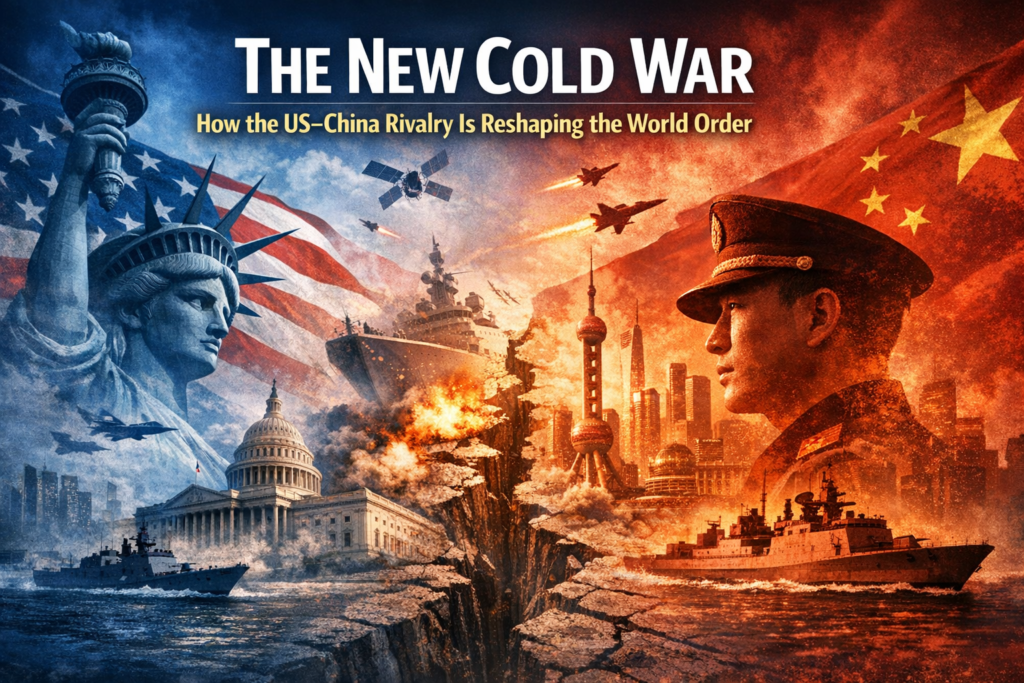
Over the past few decades, the global balance of power has been undergoing a significant transformation. At the center of this shift lies the growing rivalry between the United States and China. Many analysts, policymakers, and scholars now refer to this geopolitical competition as the “New Cold War.” Unlike the original Cold War between the United States and the Soviet Union, today’s confrontation is not defined by a single ideological battle between capitalism and communism. Instead, it is a complex struggle involving technology, trade, military influence, supply chains, global institutions, and regional alliances.
The rise of China as an economic and military power has challenged the long-standing dominance of the United States in global affairs. Over the past four decades, China has transformed from a developing nation into the second-largest economy in the world, reshaping international trade and global political dynamics. Meanwhile, the United States continues to maintain strong military capabilities, technological leadership, and a network of global alliances.
This competition between the two powers is shaping the future of international relations, influencing how countries align themselves politically and economically. From semiconductor supply chains to military tensions in the South China Sea, the implications of this rivalry extend far beyond Washington and Beijing. Understanding the new Cold War is essential for grasping the future of the global order.
Historical Background: From Cooperation to Competition
The relationship between the United States and China has not always been defined by rivalry. In fact, there were periods of cooperation that helped integrate China into the global economy.
In the late 20th century, particularly after China’s economic reforms in 1978, the country began opening its markets to international trade and investment. Western nations, including the United States, supported China’s integration into the global economy, believing that economic engagement would encourage political liberalization and strengthen international stability.
China’s accession to the World Trade Organization (WTO) in 2001 marked a major turning point. This move significantly accelerated China’s economic growth and allowed it to become the “world’s factory,” producing goods for global markets at unprecedented scale.
However, as China’s economic power expanded, tensions gradually emerged. American policymakers and businesses began expressing concerns about trade imbalances, intellectual property theft, and unfair trade practices. At the same time, China’s growing military capabilities and regional ambitions began to challenge U.S. influence in Asia.
By the late 2010s, the relationship between the two nations had shifted from cautious cooperation to strategic competition.
Economic Rivalry and the Global Trade War
One of the most visible aspects of the new Cold War is the economic competition between the United States and China.
China’s rapid economic rise has been fueled by massive manufacturing capacity, government-supported industries, and a strong export-oriented model. Today, China plays a central role in global supply chains, producing electronics, machinery, textiles, and many other goods.
The United States, on the other hand, has traditionally dominated in financial markets, advanced technology, and global services. As China began challenging American leadership in these sectors, tensions intensified.
The situation escalated dramatically during the U.S.–China trade war that began in 2018, when the United States imposed tariffs on hundreds of billions of dollars’ worth of Chinese imports. The move was intended to reduce trade imbalances and pressure China to change its economic practices.
China responded with its own tariffs on American goods, leading to a cycle of economic retaliation. The trade war disrupted global supply chains, forced companies to reconsider manufacturing locations, and contributed to rising geopolitical uncertainty.
Even though negotiations and partial agreements were reached, economic competition between the two powers continues to shape global trade dynamics.
The Technology Battle: The Real Frontline
While trade disputes capture headlines, the true battlefield of the new Cold War lies in technology.
Technological leadership is increasingly seen as the key to economic power, military strength, and geopolitical influence. As a result, both the United States and China are investing heavily in strategic technologies such as:
- Artificial intelligence
- Semiconductor manufacturing
- Quantum computing
- 5G telecommunications
- Advanced robotics
One of the most significant conflicts in this technological rivalry involves semiconductor chips, which are essential for everything from smartphones to military systems.
The United States has introduced export controls to limit China’s access to advanced semiconductor technology, aiming to slow China’s technological development in critical sectors. Meanwhile, China is investing billions of dollars into building its own domestic semiconductor industry.
The competition over technology is also visible in the global rollout of 5G networks. Chinese companies such as Huawei have become major players in telecommunications infrastructure, raising concerns in Western countries about security risks and potential surveillance.
As technology becomes more closely tied to national security, the rivalry between the United States and China is likely to intensify further.
Military Competition and Strategic Tensions
Beyond economics and technology, the new Cold War also involves growing military competition, particularly in the Indo-Pacific region.
China has been rapidly modernizing its military forces, investing in advanced missile systems, naval capabilities, and cyber warfare technologies. The Chinese navy has expanded significantly in recent years, with a growing number of aircraft carriers, submarines, and advanced warships.
At the same time, the United States maintains a strong military presence in the Asia-Pacific region, with alliances and security partnerships involving countries such as Japan, South Korea, Australia, and the Philippines.
Several key flashpoints have emerged in this strategic competition:
Taiwan
Taiwan remains one of the most sensitive geopolitical issues in the world. China considers Taiwan a part of its territory and has repeatedly stated its intention to reunify the island with the mainland, if necessary by force.
The United States, while officially supporting the “One China” policy, maintains close relations with Taiwan and provides military support to the island’s defense capabilities.
Rising tensions around Taiwan are widely viewed as one of the most dangerous potential triggers for conflict between the United States and China.
South China Sea
The South China Sea is another major area of geopolitical tension. China has built artificial islands and military installations in disputed waters, asserting territorial claims over much of the region.
Several neighboring countries, including Vietnam, the Philippines, and Malaysia, contest these claims.
The United States conducts freedom of navigation operations in the region to challenge China’s territorial assertions and ensure that international shipping routes remain open.
Given that a large portion of global trade passes through these waters, the South China Sea has become a critical geopolitical hotspot.
The Role of Alliances and Global Influence
Another major dimension of the new Cold War is the competition for global influence and alliances.
The United States has long relied on a network of international alliances and institutions to maintain its global leadership. NATO in Europe and various security partnerships in Asia form the backbone of this strategy.
China, meanwhile, has been expanding its influence through economic initiatives such as the Belt and Road Initiative (BRI), a massive infrastructure investment program connecting Asia, Europe, Africa, and beyond.
Through infrastructure projects, loans, and trade partnerships, China has strengthened its relationships with developing countries and increased its geopolitical influence.
This competition for influence has led many countries to navigate a delicate balance between the two powers. Rather than choosing sides outright, many governments seek to maintain economic ties with China while preserving security relationships with the United States.
The Fragmentation of Globalization
One of the broader consequences of the U.S.–China rivalry is the gradual fragmentation of globalization.
For decades, globalization encouraged economic integration, international trade, and cross-border cooperation. However, rising geopolitical tensions are now leading to a shift toward economic nationalism and strategic decoupling.
Companies are increasingly diversifying their supply chains to reduce reliance on a single country. Governments are implementing policies designed to protect domestic industries and secure critical technologies.
This shift is creating what some analysts describe as a “multipolar world,” where several major powers compete for influence rather than a single dominant superpower shaping global affairs.
Implications for the Future
The new Cold War between the United States and China will likely shape international politics for decades to come.
Unlike the Cold War between the United States and the Soviet Union, today’s rivalry is deeply intertwined with global economic systems. Both nations remain major trading partners and play central roles in the global economy.
This interdependence makes direct conflict less likely, but it also makes geopolitical competition more complex.
Several possible scenarios could emerge in the coming years:
- Continued strategic competition without direct military conflict
- Economic decoupling and technological separation between global blocs
- Regional conflicts triggered by disputes in areas such as Taiwan or the South China Sea
- The emergence of a multipolar world where multiple powers share influence
How these dynamics unfold will depend not only on the policies of the United States and China but also on the decisions of other countries navigating this evolving geopolitical landscape.
Conclusion
The rivalry between the United States and China represents one of the most defining geopolitical developments of the 21st century. This new Cold War is not fought through ideological propaganda alone but through economic competition, technological innovation, military positioning, and global influence.
As both nations seek to shape the future of the international system, the consequences of their rivalry will affect governments, businesses, and societies across the world.
Whether this competition leads to conflict, cooperation, or a new global balance of power remains uncertain. What is clear, however, is that the world is entering a new era of geopolitical competition—one that will redefine the global order for generations to come.