
Introduction
Over the past two decades, the global economic landscape has been gradually shifting. For much of the modern era, Western powers—particularly the United States and European nations—have dominated global financial institutions, trade systems, and economic decision-making. However, the emergence of BRICS, a coalition of major emerging economies, has introduced a new dynamic into international geopolitics and global economics.
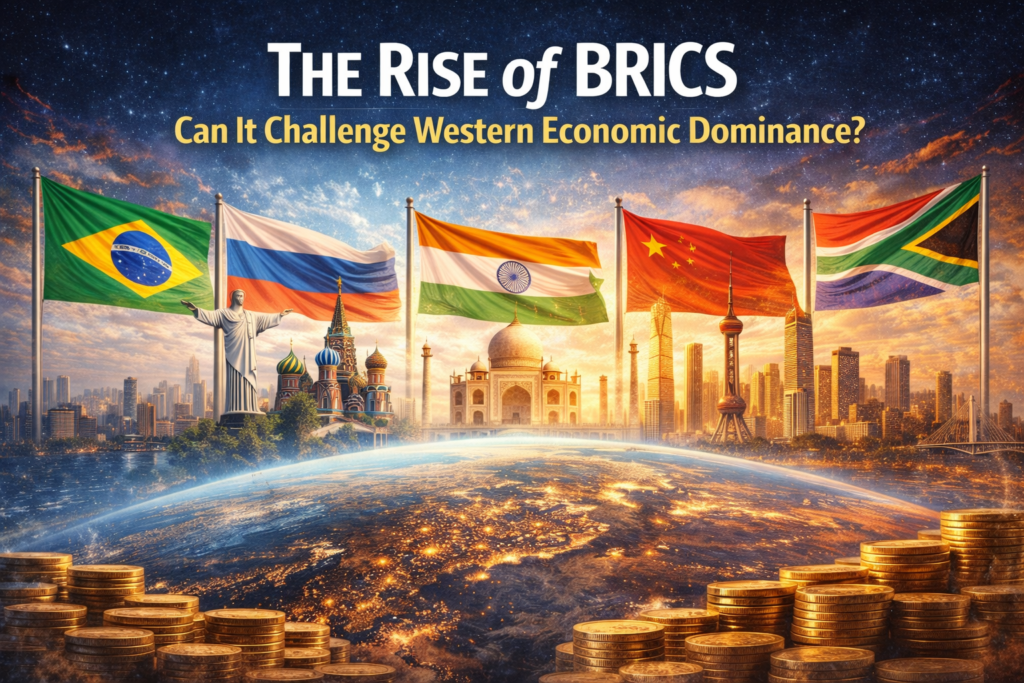
BRICS originally consisted of Brazil, Russia, India, China, and South Africa, countries that collectively represent a significant portion of the world’s population, economic growth, and natural resources. In recent years, the bloc has expanded and gained increased attention as a potential counterbalance to Western economic influence.
Many analysts now ask an important question: Can BRICS truly challenge the dominance of Western-led institutions like the IMF, World Bank, and the US dollar-based financial system?
To answer this, we need to examine the origins of BRICS, its economic power, its goals, and the challenges it faces in reshaping the global order.
The Origins of BRICS
The concept of BRICS first emerged in 2001 when economist Jim O’Neill from Goldman Sachs used the acronym BRIC (Brazil, Russia, India, China) to describe emerging economies that were expected to play a major role in the global economy during the 21st century.
These nations shared several characteristics:
- Large populations
- Rapid economic growth
- Expanding middle classes
- Increasing global influence
Recognizing their shared interests, the four countries began holding annual meetings to discuss economic cooperation and global governance reforms.
In 2010, South Africa joined the group, turning BRIC into BRICS and expanding its representation to include Africa.
Since then, BRICS has evolved from an informal economic grouping into a more structured geopolitical alliance seeking to increase the influence of emerging economies in global decision-making.
Economic Power of BRICS
One of the main reasons BRICS attracts so much global attention is the collective economic strength of its members.
Together, BRICS countries represent:
- Around 40–45% of the world’s population
- Nearly one-quarter of global GDP
- A large share of global natural resources
- Some of the fastest-growing emerging markets
China alone plays a particularly dominant role within the group. As the world’s second-largest economy and a major manufacturing hub, China contributes a significant portion of BRICS’ overall economic output.
India is also rapidly emerging as one of the fastest-growing major economies, with a young population and expanding technology sector.
Brazil and Russia contribute vast natural resources, including energy, agriculture, and minerals, while South Africa provides an important economic gateway to the African continent.
This combination of industrial capacity, natural resources, and demographic potential gives BRICS significant economic influence on the global stage.
The Push for a Multipolar World
A key objective of BRICS is to promote a multipolar world order, where power is distributed among several major countries rather than dominated by a single bloc of Western nations.
Many BRICS members have expressed concerns that global financial institutions such as the International Monetary Fund (IMF) and the World Bank disproportionately favor Western interests.
For example, voting power within these institutions is heavily influenced by economic contributions historically made by Western countries, giving them greater influence over global financial policies.
BRICS nations have argued that these institutions should be reformed to better reflect the economic realities of the modern world, where emerging markets play a far larger role than they did in the mid-20th century.
In response to these concerns, BRICS countries have created alternative institutions aimed at increasing financial independence and cooperation among developing nations.
The New Development Bank
One of the most significant initiatives launched by BRICS is the New Development Bank (NDB).
Established in 2014, the NDB was created to provide funding for infrastructure and development projects in emerging economies. The bank aims to serve as an alternative to Western-dominated institutions like the World Bank and the IMF.
The NDB focuses on financing projects related to:
- Infrastructure development
- Renewable energy
- Sustainable urban development
- Transportation networks
- Environmental protection
Unlike traditional financial institutions, the NDB emphasizes equal voting rights among its founding members and aims to simplify loan approval processes for developing countries.
This initiative reflects BRICS’ broader goal of creating financial systems that better serve emerging economies.
The Debate Over De-Dollarization
Another major topic associated with BRICS is the potential challenge to the dominance of the US dollar in global trade and finance.
For decades, the US dollar has been the primary currency used in international trade, global reserves, and financial transactions. This gives the United States significant economic influence, including the ability to impose financial sanctions that can impact countries worldwide.
Some BRICS nations have expressed interest in reducing dependence on the dollar by expanding trade using their own currencies.
Efforts toward de-dollarization include:
- Bilateral trade agreements using local currencies
- Increasing gold reserves
- Exploring the possibility of a shared BRICS currency for international trade
While these initiatives are still in early stages, they highlight the desire among some countries to create alternatives to the dollar-based financial system.
However, replacing or even significantly weakening the dollar’s dominance would be extremely difficult due to its deep integration into global financial markets.
Expansion of the BRICS Bloc
In recent years, interest in joining BRICS has increased significantly among developing countries.
Several nations in the Middle East, Africa, and Latin America have expressed interest in membership, seeing BRICS as a platform to increase their global influence and reduce dependence on Western-led institutions.
The expansion of BRICS could potentially increase its geopolitical and economic influence by:
- Expanding trade networks
- Strengthening energy cooperation
- Increasing political coordination among emerging economies
However, rapid expansion could also introduce new challenges related to coordination, governance, and differing national interests.
Internal Challenges Facing BRICS
Despite its growing influence, BRICS also faces several internal challenges that could limit its ability to function as a unified bloc.
One major challenge is the diversity of political systems and strategic interests among its members.
For example:
- China and India have ongoing border disputes and strategic rivalry.
- Russia faces international sanctions that complicate economic cooperation.
- Brazil and South Africa often prioritize regional issues over global geopolitical competition.
These differences make it difficult for BRICS to adopt unified positions on many global issues.
Additionally, China’s dominant economic size within the group sometimes raises concerns among other members about maintaining balanced decision-making.
The Future of BRICS in Global Politics
Despite these challenges, BRICS is likely to remain an important force in global geopolitics.
The group represents a broader shift in global power toward emerging economies that are seeking greater representation and influence in international institutions.
As global economic growth increasingly occurs outside traditional Western economies, organizations like BRICS may play a growing role in shaping international trade, finance, and development policies.
However, it is unlikely that BRICS will fully replace Western-led institutions in the near future. Instead, the global system may evolve into a more multipolar structure, where multiple economic centers share influence over global governance.
Conclusion
The rise of BRICS reflects a broader transformation in the global balance of power. As emerging economies continue to grow and expand their influence, they are increasingly seeking greater participation in shaping international economic systems.
Through initiatives like the New Development Bank and efforts to promote financial cooperation among developing countries, BRICS represents an attempt to create alternatives to traditional Western-dominated institutions.
While the bloc still faces internal challenges and structural limitations, its growing economic weight and geopolitical influence make it a significant factor in the evolving global order.
The future of BRICS will depend on its ability to strengthen cooperation among its members, expand its partnerships, and navigate the complex realities of international geopolitics.
Regardless of the outcome, the rise of BRICS signals an important shift toward a world where power is more widely distributed among emerging economies.