
Introduction
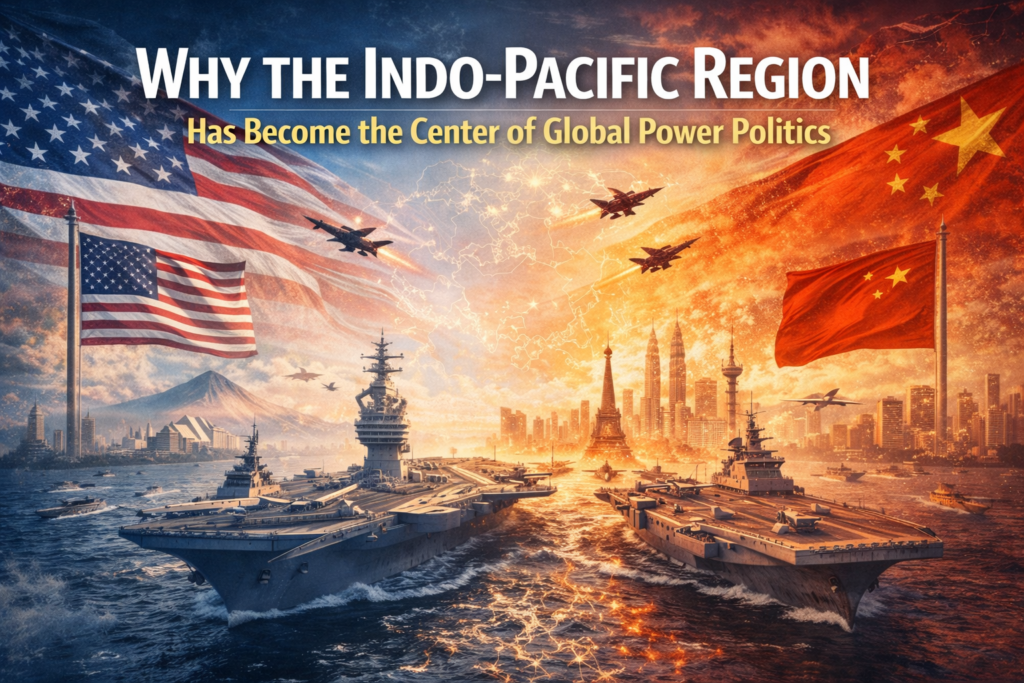
Over the past two decades, the Indo-Pacific region has emerged as the most strategically important region in global geopolitics. Stretching from the eastern coast of Africa across the Indian Ocean to the western Pacific Ocean, the Indo-Pacific connects some of the world’s fastest-growing economies, busiest trade routes, and most significant military powers.
Today, major global powers—including the United States, China, India, Japan, and Australia—are increasingly focusing their diplomatic, economic, and military strategies on this region. The Indo-Pacific is not only home to more than half of the world’s population but also responsible for a large share of global economic activity and maritime trade.
As global power shifts from the Atlantic to Asia, the Indo-Pacific has become the central arena where the future balance of power will be decided. Understanding why this region has gained such importance requires examining its economic significance, strategic geography, military tensions, and the alliances shaping the new geopolitical landscape.
The Geographic Importance of the Indo-Pacific
Geography has always played a crucial role in geopolitics, and the Indo-Pacific region holds immense strategic value due to its location and maritime routes.
The region includes several critical sea lanes that carry a massive portion of global trade. Major shipping routes pass through areas such as:
- The Malacca Strait
- The South China Sea
- The Indian Ocean
- The Lombok and Sunda Straits
Nearly 60–70% of global maritime trade flows through these waters. Essential commodities like oil, natural gas, electronics, and manufactured goods travel through these routes every day.
For example, energy supplies from the Middle East are transported through the Indian Ocean and the Strait of Malacca to major Asian economies such as China, Japan, and South Korea. Any disruption to these shipping lanes could have serious consequences for the global economy.
Because of this strategic geography, controlling or influencing the Indo-Pacific sea routes has become a top priority for many countries.
Economic Powerhouses of the Region
The Indo-Pacific region is home to some of the largest and fastest-growing economies in the world.
Countries such as China, India, Japan, South Korea, Indonesia, and Australia play a major role in global trade, manufacturing, and technological innovation.
China has become the world’s second-largest economy and a central hub for global manufacturing. Meanwhile, India is emerging as one of the fastest-growing major economies, with a rapidly expanding population and technology sector.
Japan and South Korea remain global leaders in high-tech industries such as semiconductors, electronics, and automotive manufacturing.
Southeast Asian nations, including Vietnam, Indonesia, and Thailand, are also gaining importance as alternative manufacturing centers as companies diversify their supply chains.
Because so much economic activity is concentrated in this region, it naturally becomes the focus of global geopolitical competition.
The Rise of China and Regional Power Shifts
One of the biggest reasons the Indo-Pacific has become the center of global power politics is the rise of China.
Over the past four decades, China has experienced rapid economic growth and has significantly expanded its military capabilities. This rise has shifted the regional balance of power and challenged the long-standing influence of the United States in Asia.
China has also been expanding its strategic presence through projects such as the Belt and Road Initiative (BRI). This massive infrastructure program aims to connect Asia, Africa, and Europe through roads, ports, railways, and energy projects.
In the Indo-Pacific region specifically, China has been investing heavily in ports and maritime infrastructure across countries such as Pakistan, Sri Lanka, and Myanmar.
While China describes these projects as economic development initiatives, some countries and analysts view them as efforts to expand Beijing’s geopolitical influence.
This growing influence has created both opportunities and concerns among neighboring nations.
The South China Sea Disputes
The South China Sea has become one of the most contested regions in the Indo-Pacific.
China claims sovereignty over a large portion of the South China Sea through what is known as the “nine-dash line.” However, several other countries—including Vietnam, the Philippines, Malaysia, and Brunei—also claim parts of these waters.
The South China Sea is extremely important for several reasons:
- It is a major global shipping route.
- It contains significant oil and natural gas reserves.
- It has rich fishing resources that support millions of livelihoods.
In recent years, China has constructed artificial islands and military installations in disputed areas, increasing tensions with neighboring countries.
Other nations, including the United States, have responded by conducting freedom of navigation operations to challenge territorial claims and ensure that international shipping routes remain open.
These tensions highlight how the Indo-Pacific region has become a focal point for geopolitical competition.
The Role of Strategic Alliances
Another major factor shaping Indo-Pacific geopolitics is the development of strategic alliances and partnerships.
Several countries are strengthening their security cooperation to maintain regional stability and balance the rise of China.
One of the most notable partnerships is the Quadrilateral Security Dialogue (QUAD), which includes:
- The United States
- India
- Japan
- Australia
The QUAD focuses on promoting a free and open Indo-Pacific, strengthening maritime security, and enhancing economic and technological cooperation among its members.
Another important security partnership is AUKUS, an agreement between Australia, the United Kingdom, and the United States aimed at strengthening defense cooperation and providing Australia with nuclear-powered submarine technology.
These alliances demonstrate how countries are increasingly coordinating their strategies to address the challenges emerging in the Indo-Pacific region.
India’s Growing Strategic Role
India is also becoming an increasingly important player in Indo-Pacific geopolitics.
Due to its geographic position between the Middle East and East Asia, India has significant influence over the Indian Ocean region. The country has been expanding its naval capabilities and strengthening partnerships with other Indo-Pacific nations.
India’s “Act East Policy” aims to deepen economic and strategic ties with Southeast Asian countries while promoting regional connectivity and cooperation.
As tensions rise between major powers, India is pursuing a strategy of strategic autonomy, maintaining relationships with multiple partners while avoiding direct alignment with any single bloc.
This balanced approach allows India to play a crucial role in shaping the future geopolitical dynamics of the Indo-Pacific.
Technological and Economic Competition
The Indo-Pacific is not only a center for military competition but also for technological and economic rivalry.
Countries in the region are competing to dominate emerging technologies such as:
- Artificial intelligence
- Semiconductor manufacturing
- 5G telecommunications
- Renewable energy systems
Control over these technologies can determine future economic competitiveness and national security.
As a result, governments are investing heavily in innovation and industrial policies designed to strengthen their technological leadership.
The region is also becoming a key battleground for supply chains, particularly in industries such as semiconductors and rare earth minerals.
Challenges and Risks
While the Indo-Pacific presents enormous opportunities for economic growth and cooperation, it also faces several challenges.
These include:
- Territorial disputes in the South China Sea
- Rising military competition between major powers
- Economic dependency among regional economies
- Climate change and environmental pressures
- Maritime security threats such as piracy
Managing these challenges requires diplomatic engagement, regional cooperation, and effective conflict-resolution mechanisms.
Without careful management, tensions in the region could escalate and disrupt global stability.
Conclusion
The Indo-Pacific region has become the central stage for global power politics in the 21st century. Its strategic geography, economic importance, and growing military tensions make it one of the most critical regions in the world.
As major powers compete for influence and regional nations seek to protect their interests, the Indo-Pacific will continue to shape the future of global geopolitics.
Whether the region evolves into a zone of cooperation or a hotspot of geopolitical conflict will depend on how countries manage their rivalries and partnerships.
What is certain, however, is that the Indo-Pacific will remain at the heart of international politics for decades to come.